Playmobil × AI: a workshop for learning to tell stories in images.
A miniature world, a brand or a fictional universe, three images. And a question: how do you carry a creative intention from one scene to the next?
This Playmobil × AI exploration is more than a style exercise or a bit of creative entertainment. It brings us face to face with our relationship to stories, brands and collective imagery. Working through prompts teaches us to think in sequences, anticipate shifts in meaning and encode our visual intentions.
I designed this workshop around familiar territory: Playmobil. Participants combine that world with a brand or a fictional universe, then build a story in three images. Play makes the first ideas accessible. The series forces you to make your choices more precise.
Workshop objectives
- Maintain visual and narrative coherence across several prompts
- Adjust parameters and descriptions to follow the logic of a series
- Understand the role of persistent elements (characters, accessories, settings)
- Work with references between images in the prompt (e.g. “the same character”, “in the same room”)
Themes
Playmobil x IKEA
Slides
Slide 1
Giant flat-pack parcels delivered to a Playmobil apartment.
Slide 2
Confused characters facing assembly instructions (upside-down table, missing screws).
Slide 3
An unlikely final result, but the residents are proud (table assembled upside down, lamp on the floor).
Playmobil x Patagonia
Slides
Slide 1
Weather briefing for a high-risk hike (compass, map, backpack).
Slide 2
Extreme conditions: rain, wind, a tent flying away.
Slide 3
Sunset around the fire with marshmallows and laughter.
Playmobil x Tesla
Slides
Slide 1
Playmobil characters charge their Tesla at a Supercharger (with a hot-dog stand next door).
Slide 2
The car is on autopilot, but a glitch sends it on an absurd detour to a funfair.
Slide 3
They end up camping in the Tesla, in “digital vanlife” mode.
Playmobil x Apple
Slides
Slide 1
A queue for the launch of the iPlayPhone 28.
Slide 2
The Playmobil characters test the new model’s absurd features (360 camera, soul scanner).
Slide 3
Back home, they frame the packaging as a work of art.
Playmobil x Stranger Things
Slides
Slide 1
Playmobil children discover a flashing light in the basement.
Slide 2
A portal to a parallel world (melted rooms, stylised monsters).
Slide 3
One of them returns changed… a reversed hairstyle and a strange gaze.
Playmobil x Fortnite
Slides
Slide 1
Playmobil characters drop into a colourful battle royale.
Slide 2
They find weapons and build a cardboard base.
Slide 3
They perform an unlikely dance emote after a victory.
Playmobil x Nintendo
Slides
Slide 1
A Mario Kart race in the Playmobil kitchen.
Slide 2
Objects being thrown: shells, banana skins, sugary explosions.
Slide 3
The winner receives a star and a giant pizza.
Playmobil x Banksy
Slides
Slide 1
A mysterious mural appears in the Playmobil town.
Slide 2
Miniature police officers try to erase it.
Slide 3
The Playmobil characters make a giant replica in protest.
Playmobil x Fondation Louis Vuitton
Slides
Slide 1
An exhibition opening with Playmobil characters in tuxedos and elegant dresses.
Slide 2
The audience rejects an absurd artwork (a giant spoon).
Slide 3
The artwork ends up in a miniature museum for children.
Playmobil x Pantone
Slides
Slide 1
Each character represents a Pantone colour.
Slide 2
They are separated into monochrome settings.
Slide 3
Everyone reunites in an explosion of rainbow colours.
Playmobil x Station F
Slides
Slide 1
Startup pitch: “an app for renting living Playmobil characters”.
Slide 2
A meeting with investors in suits and ties.
Slide 3
The idea gets approved, the Playmobil characters are rich… but far too stressed.
Playmobil x Deliveroo
Slides
Slide 1
An order placed on a Playmobil tablet.
Slide 2
Delivery riders on bikes or in helicopters arrive late.
Slide 3
The wrong delivery… but everyone eats what they received together.
Playmobil x Business school student association
Slides
Slide 1
Preparing a party with a communications plan and flyers.
Slide 2
The party gets out of hand (DJ glitches, foam takes over everything).
Slide 3
The next day, a rough morning… and a Playmobil character lost in the fountain.
Playmobil x La Poste
Slides
Slide 1
A very important parcel is sent.
Slide 2
The postman gets lost in an administrative maze.
Slide 3
The parcel arrives… at the wrong Playmobil character’s home (who keeps everything).
The method
Here I will walk through the example of
Playmobil x Red Bull 🚗
Slide 1: Playmobil characters customise DIY racers (with Red Bull cans).
Slide 2: A downhill race with epic stunts.
Slide 3: A spectacular crash… but everyone celebrates around a cardboard podium.
🏁 Overall narrative context & Markdown
Playmobil characters build DIY racers for a Red Bull-sponsored soapbox race. The world is absurd and ultra-colourful, but coherent from one image to the next. We want to keep the same characters, the same urban hillside setting and a progression in the action.
With this context, we can already ask an LLM (large language model) to help us create a structured Markdown prompt with variables* (the elements that can change).
We can also draw on a structure like this: here, each element enclosed in ** will appear in bold and therefore carry more weight in the prompt.
**Characters**: Four Playmobil characters in absurd DIY racers (hot dog, rocket, bathtub).
**Location**: A sloping street in a miniature neighbourhood, cartoon style.
**Action**: They launch at full speed, two hit a ramp, one skids.
**Atmosphere**: Bright sunshine, a cheering crowd, a sense of speed.
**Key objects**: Soapbox racers, Red Bull flags, supporters’ signs.
Markdown becomes a mental and creative framework to:
- Encourage structured ideas
- Guide generation step by step
- Make intentions traceable (“why did it turn out like this?”)
There are plenty of online Markdown editors. You can also use a Google Doc, an IDE (integrated development environment) or a simple notepad.
I use a mix of https://stackedit.io/app# and Notion depending on how much traceability I want when creating prompts.
Prompts and images, slide by slide
**Playmobil scene — Slide 1/3**

**Characters**: Four Playmobil characters in DIY outfits (helmets, goggles, colourful overalls), smiling and busy building their racers.

**Location**: The foot of a gently sloping hill, a miniature cartoon-style urban neighbourhood, Red Bull signs around it.

**Action**: The characters paint their soapbox racers; one holds a spanner, another applies a Red Bull sticker. A small stand with Red Bull cans in the background.

**Atmosphere**: A sunny afternoon, warm light, blue sky with a few stylised clouds.

**Key objects**: Soapbox racers being assembled, a workbench, a toolbox, a “Start” sign.

A realistic miniature diorama image with Playmobil toys. Dynamic composition with visible details, a slightly elevated viewpoint.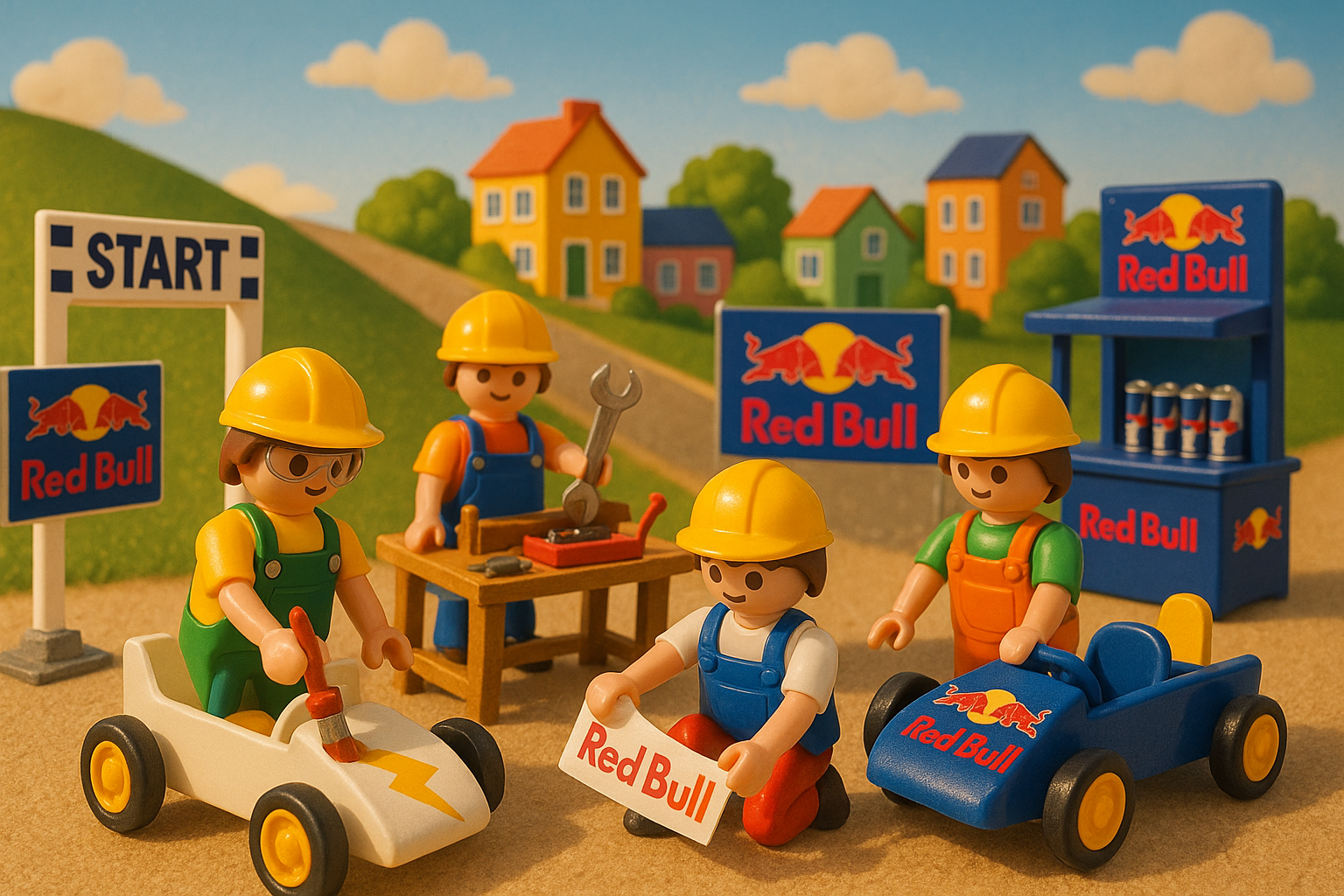
**Playmobil scene — Slide 2/3**

**Characters**: The same four Playmobil characters in their racers (absurd shapes: rocket, bathtub, giant hot dog), focused expressions, arms raised or actively driving.

**Location**: Down the hill, a sharp bend, Playmobil spectators cheering along the sides, some holding banners.

**Action**: Two racers are airborne after a ramp; one is skidding. A giant Red Bull can rolls out of control along the side.

**Atmosphere**: The sky is still blue but a little more dramatic (a sense of speed). Dust, movement, motion blur on the wheels.

**Key objects**: Customised racers, a papier-mâché track, a ramp, a cloud of dust.

Still in a miniature diorama style with Playmobil toys. Suggested movement, consistent characters and outfits.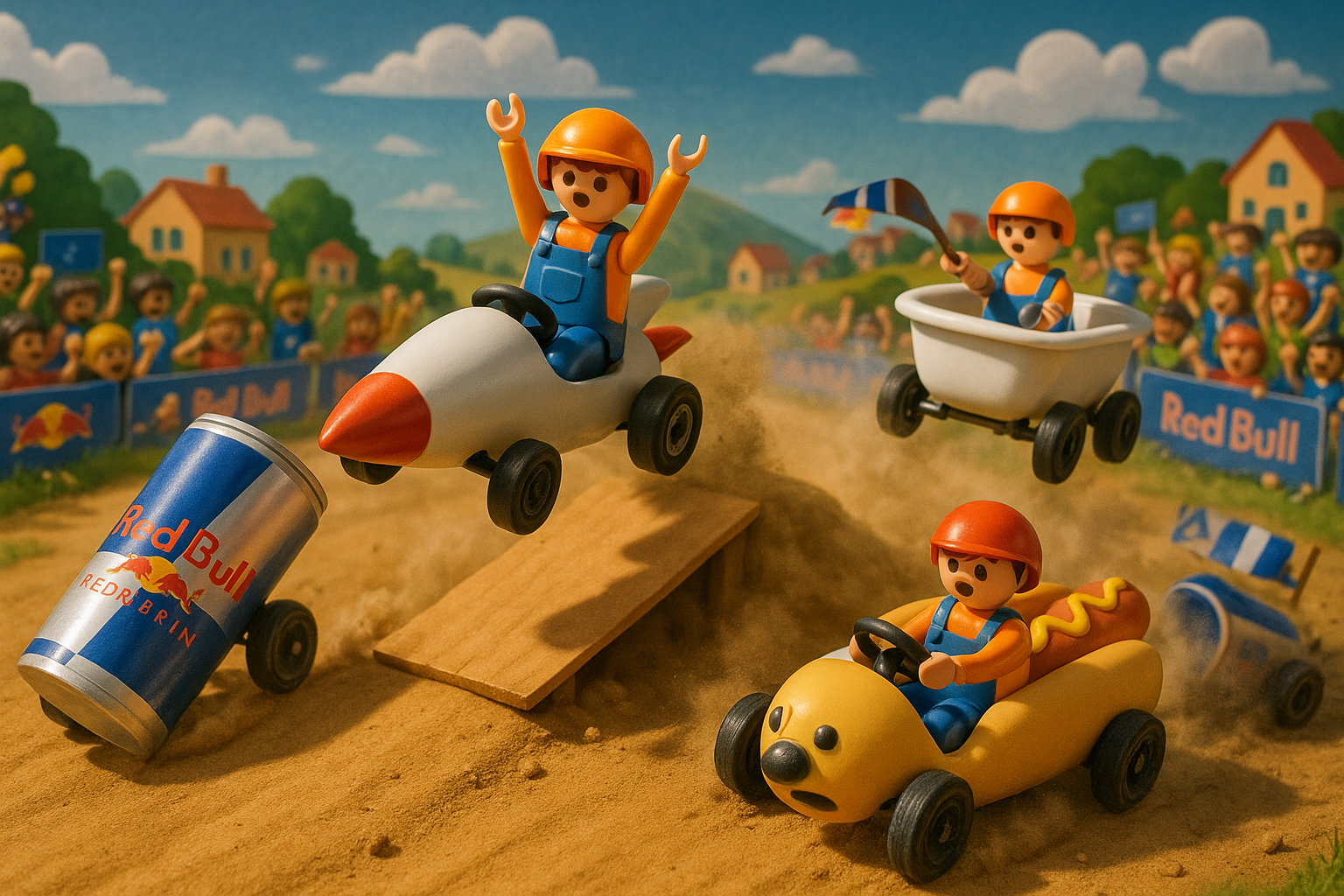
**Playmobil scene — Slide 3/3**

**Characters**: The four Playmobil characters on a podium built from Red Bull crates. One has a cast; another sprays everyone with a bottle of soda.

**Location**: The end of the track, the finish area. Red and blue flags flying, a cheering crowd.

**Action**: The characters celebrate their victory (or their crash) in an absurd way. A bathtub car is framed like a work of art.

**Atmosphere**: Golden late afternoon, a stylised sunset, warm light.

**Key objects**: A crate-built podium, a strange trophy, signs, wrecked racer parts.

Still in a photorealistic miniature Playmobil scene style. Centred composition, a festive atmosphere.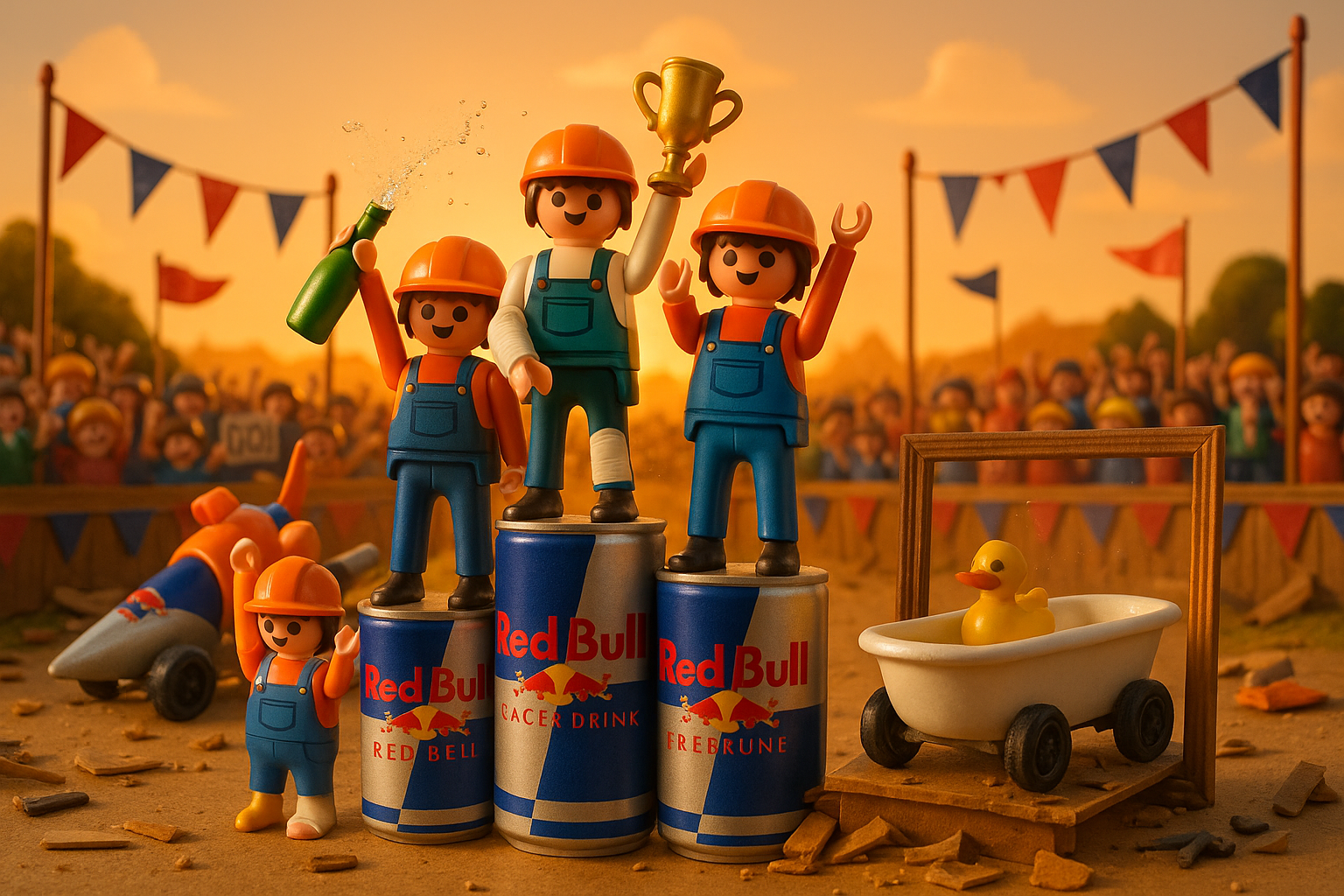
How to improve the results
I mentioned how important narrative context is when responding to a brief that fits into a broader strategy. With AI, the exercise stays the same. For example, we can:
- Establish constants from the start: character(s), setting, visual style, atmosphere.
➜ As in animation: if everything changes from one shot to the next, the eye loses the thread.
- Write the prompt as a sequence with cause-and-effect links:
- Slide 1 = setup → Slide 2 = tension → Slide 3 = resolution (even an absurd one)
- You can work with an emotional progression: calm > chaos > catharsis
- Use language as memory:
- “The same character as in the previous slide”
- “Still in the room filled with foam”
This guides the AI without requiring a continuity engine.
I adapt these examples to the results I get from different diffusion models, but the process stays the same.
- I define an overall context as in theatre (unity of time, place and action), adding details about the subject, atmosphere, format and so on.
- I check the result.
- I iterate by adjusting the parameters.
- I finish the result in a layout or image-editing application.